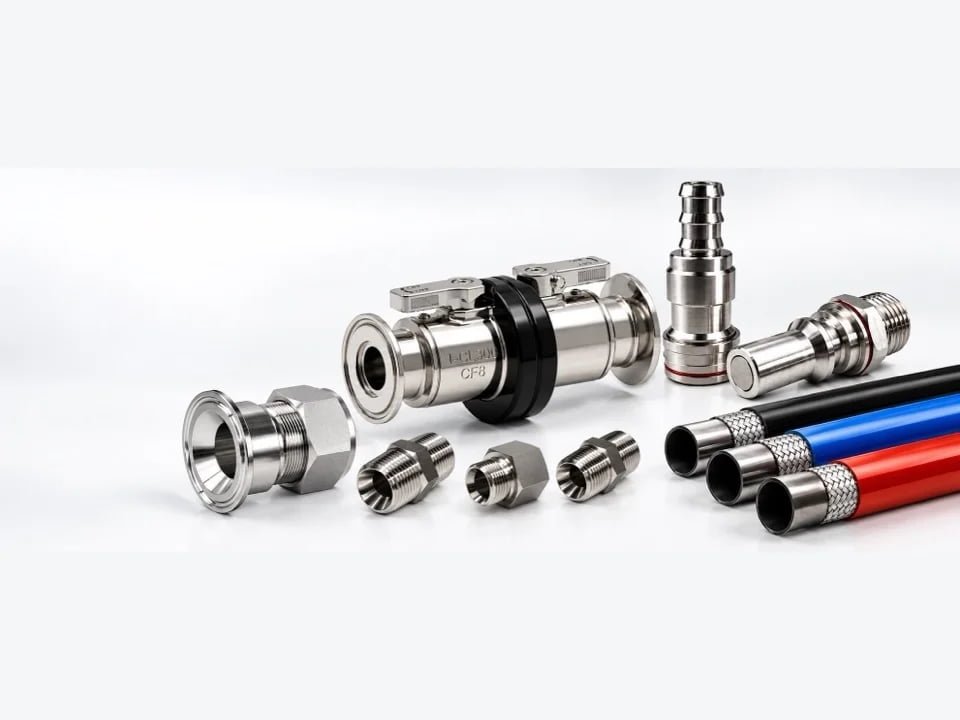
Data center cooling systems face growing heat loads. Poor fittings increase pressure loss and leakage risks. I believe the right connections are essential for reliable liquid cooling.
Data center liquid cooling fittings connect pipes, hoses, manifolds, and cooling equipment to circulate coolant safely. I recommend stainless steel fittings, properly sized valves, flexible hoses, and OCP-compatible quick disconnect couplings. The best selection depends on flow rate, pressure drop, coolant compatibility, and maintenance requirements.
After more than 15 years in the stainless steel fittings industry, I have learned that a small connection component can affect an entire fluid system. In this guide, I explain how I evaluate liquid cooling fittings for data centers, compare materials, and select connections that balance reliability, performance, and cost.
What Are Data Center Liquid Cooling Fittings?
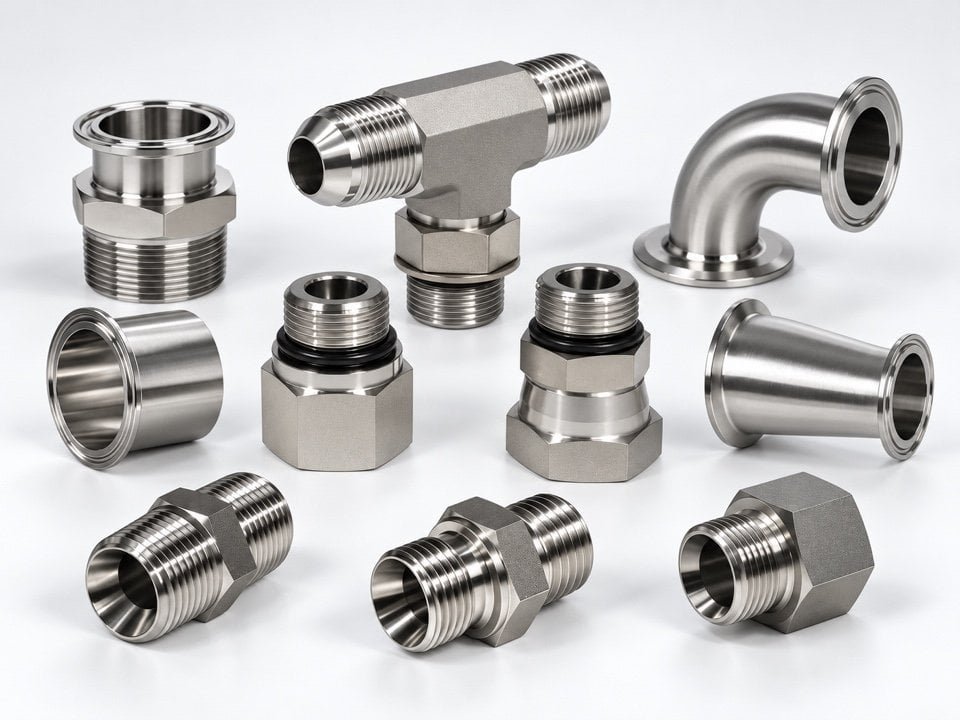
A liquid cooling system depends on many small connections. Poor fitting selection creates leakage and flow restrictions. I treat every fitting as part of the cooling system’s performance.
Data center liquid cooling fittings are mechanical components that connect coolant lines, distribution manifolds, cold plates, and cooling distribution units. They include pipe fittings, hose connectors, valves, and quick disconnect couplings that maintain sealed coolant flow throughout the system.
How Liquid Cooling Systems Work

I divide a typical direct-to-chip liquid cooling system into three main parts.
The first part is the Cooling Distribution Unit (CDU). It transfers heat between the facility cooling system and the technology cooling loop. Depending on the design, the CDU may include pumps, filters, sensors, and heat exchangers.
The second part is the coolant distribution network. This network includes supply pipes, return pipes, rack manifolds, valves, and flexible hoses.
The third part is the cooling equipment inside the server. Cold plates absorb heat from processors and other high-power components. The coolant carries this heat away.
I use the following simplified rack-drop connection diagram to explain the flow path.
                 COOLING DISTRIBUTION UNIT
                          (CDU)
                            |
               +------------+------------+
               |                         |
          SUPPLY LINE                RETURN LINE
               |                         |
         Isolation Valve           Isolation Valve
               |                         |
         Supply Manifold           Return Manifold
               |                         |
         UQD Coupling              UQD Coupling
               |                         |
          Flexible Hose             Flexible Hose
               |                         |
               +------ SERVER -----------+
                      COLD PLATE
Figure: Simplified direct-to-chip liquid cooling rack connection. Actual layouts depend on the system design.
I pay special attention to the connections between the rack manifold and server hoses. These connections may be disconnected during server replacement or maintenance.
Why Reliable Connections Matter
I consider leakage prevention the first requirement because cooling liquid and electronic equipment operate close together.
Even a small leak can create serious problems. Coolant may reach sensitive components, reduce system availability, and increase maintenance costs.
I also consider pressure drop.
Every elbow, valve, hose, and quick disconnect creates some resistance to flow. Excessive resistance increases the pressure that the pump must provide.
A higher pump requirement can increase energy consumption and operating costs.
I therefore evaluate fittings against four practical requirements:
- Dependable sealing under normal operation and pressure changes.
- Sufficient internal flow passages to avoid unnecessary restrictions.
- Verified coolant and seal compatibility.
- Convenient installation access and future maintenance.
I never assume that a fitting suitable for a high-pressure hydraulic machine is automatically the best choice for a data center.
Cooling systems often operate at much lower pressures, but they may require better flow performance, cleaner internal surfaces, and more frequent connection cycles.
Types of Data Center Liquid Cooling Fittings?
A data center uses different fittings for different purposes. Selecting one connection type for every location creates unnecessary restrictions. I match each fitting to its function.
The main types of data center liquid cooling fittings are stainless steel pipe fittings, isolation valves, flexible hose assemblies, and quick disconnect couplings. Pipe fittings provide permanent connections, valves control flow, hoses absorb movement, and quick disconnects allow fast equipment replacement.
Stainless Steel Pipe Fittings
I use stainless steel pipe and tube fittings for fixed cooling lines, manifold connections, and equipment interfaces.

Common types include:
- Straight unions and adapters
- Elbows and tees
- Reducers
- Bulkhead connectors
- Threaded connectors
- Compression tube fittings
I select the connection style according to the pipe material, tube dimensions, sealing method, and maintenance requirements.
For example, I may use stainless steel twin-ferrule instrumentation fittings for smaller rigid tubing connections. These fittings provide a mechanical seal without welding when they are correctly matched to suitable tubing.
For threaded connections, I check the thread standard carefully.
NPT, BSPP, BSPT, and SAE O-ring boss connections are not interchangeable. I never rely on matching nominal sizes alone.
I also pay attention to internal cleanliness. Cutting debris, metal particles, and damaged sealing surfaces can affect narrow cold-plate channels.
Dry Break Dual Interlock Quick Coupling Ball Valves
I recommend dry break dual interlock quick coupling ball valves for data center liquid cooling systems where technicians need to disconnect cooling lines safely. Traditional ball valves provide isolation, but they often require additional connectors and handling steps. I prefer integrated solutions that combine flow isolation with quick disconnection.
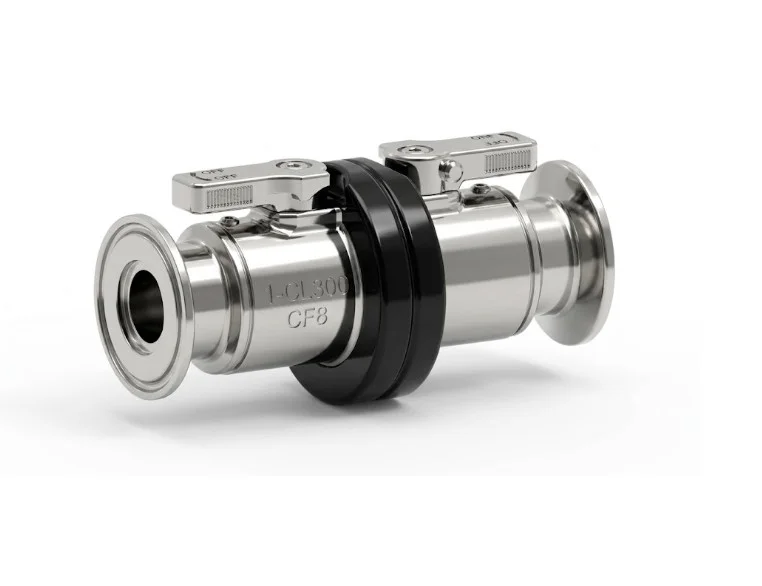
How Do Dry Break Dual Interlock Quick Coupling Ball Valves Work?
Dry break dual interlock quick coupling ball valves combine shutoff functionality with a quick disconnect connection.
The dry break design helps minimize coolant leakage during disconnection. The dual interlock mechanism adds protection against accidental release by requiring the intended unlocking sequence before separation.
I consider these features particularly useful in data centers because cooling connections may be located close to sensitive electronic equipment.
A conventional ball valve can stop coolant flow, but technicians may still need to disconnect a separate fitting. An integrated dry break coupling can simplify this process when the system is designed for the appropriate connection sequence.
Why Do I Recommend Dual Interlock Designs for Data Center Cooling?
I focus on three requirements: leakage prevention, operational safety, and maintenance efficiency.
The dry break mechanism helps reduce coolant spillage during planned maintenance. The dual interlock design helps prevent unintended disconnection. The ball valve function provides controlled isolation of the cooling line.
I evaluate the following features when selecting these couplings:
| Coupling Feature | My Selection Priority |
|---|---|
| Dry break mechanism | Minimize coolant spillage during disconnection |
| Dual interlock design | Reduce the risk of accidental release |
| Ball valve function | Provide reliable flow isolation |
| Body material | Ensure coolant compatibility and corrosion resistance |
| Seal material | Match coolant chemistry and operating temperature |
| Internal flow diameter | Minimize unnecessary pressure drop |
| Pressure rating | Meet maximum operating and test conditions |
| Connection interface | Match the cooling pipe or hose assembly |
Where Are These Couplings Used?
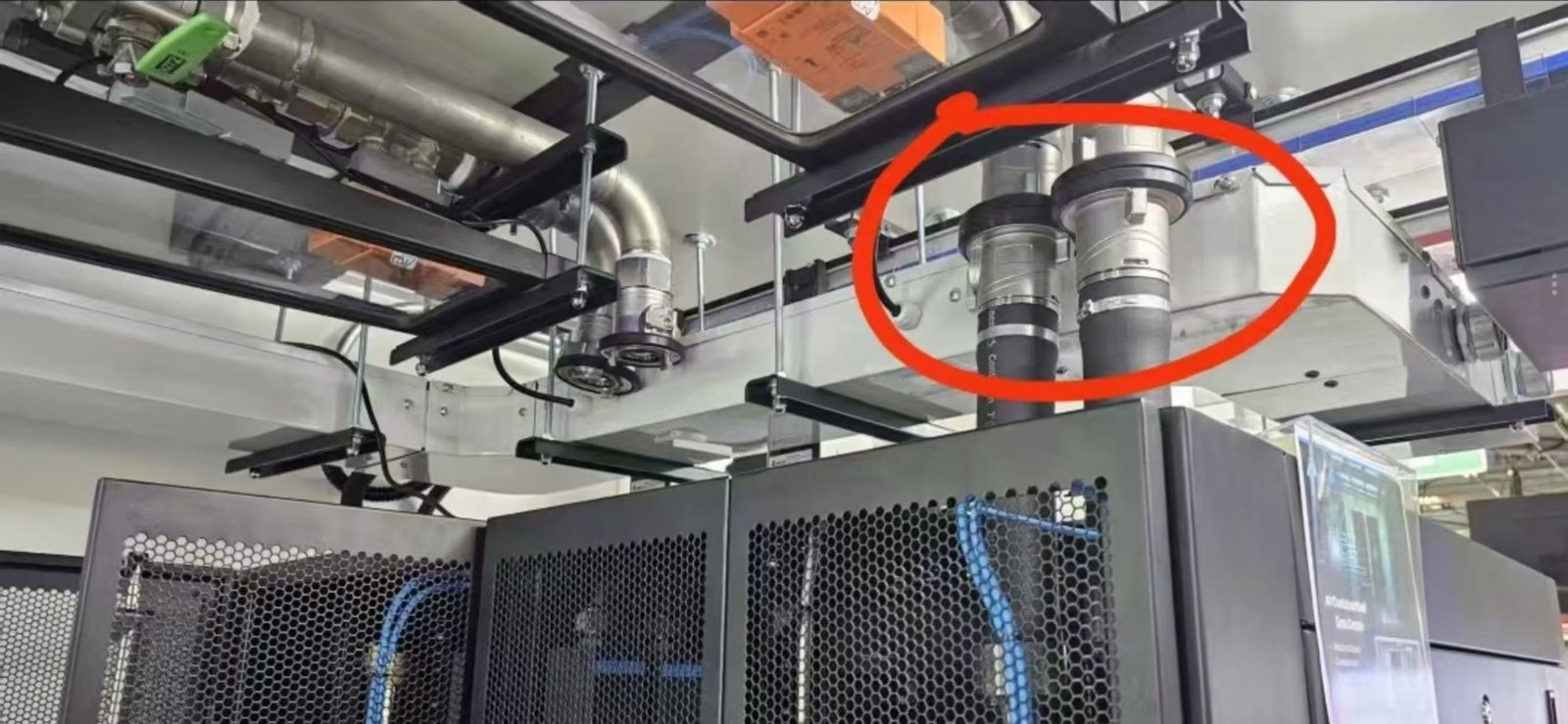
I recommend evaluating dry break dual interlock quick coupling ball valves for rack cooling branches, coolant distribution manifolds, and service connections where frequent maintenance is expected.
For example, technicians may need to isolate and disconnect a cooling branch during equipment replacement. A suitable dry break coupling can reduce residual coolant release and simplify maintenance.
I still verify the operating sequence, pressure rating, flow performance, and seal compatibility before approving the product.
At TICOOLFLOW POWERED BY TITAN FLUID, I focus on helping customers select liquid cooling connections that combine reliable sealing, practical maintenance, and suitable hydraulic performance.
Flexible Hose Assemblies

I use flexible hoses where equipment movement, vibration, or tight routing makes rigid tubing impractical.
Inside a rack, flexible hoses connect the manifold to server cold plates or quick disconnects.
The hose must have enough flexibility for installation, but it must also maintain its internal diameter without kinking.
I check five details before approving a hose assembly:
- Hose material
- Internal diameter
- Minimum bend radius
- End-fitting design
- Assembly pressure rating
I also review the crimping process when stainless steel crimp fittings are used.
A high-quality stainless steel fitting cannot compensate for an incorrectly crimped hose.
I therefore require the hose, ferrule, fitting, and crimp specifications to be qualified as one assembly.
For relevant connection components, I recommend exploring the stainless steel hydraulic hose fittings available through TICOOLFLOW POWERED BY TITAN FLUID.
Quick Disconnect Couplings

I consider quick disconnect couplings among the most important components in modern direct-to-chip liquid cooling systems.
These couplings allow technicians to disconnect servers or cooling modules without dismantling permanent piping.
I prefer flat-face, double-shutoff designs when low spillage and limited air inclusion are important.
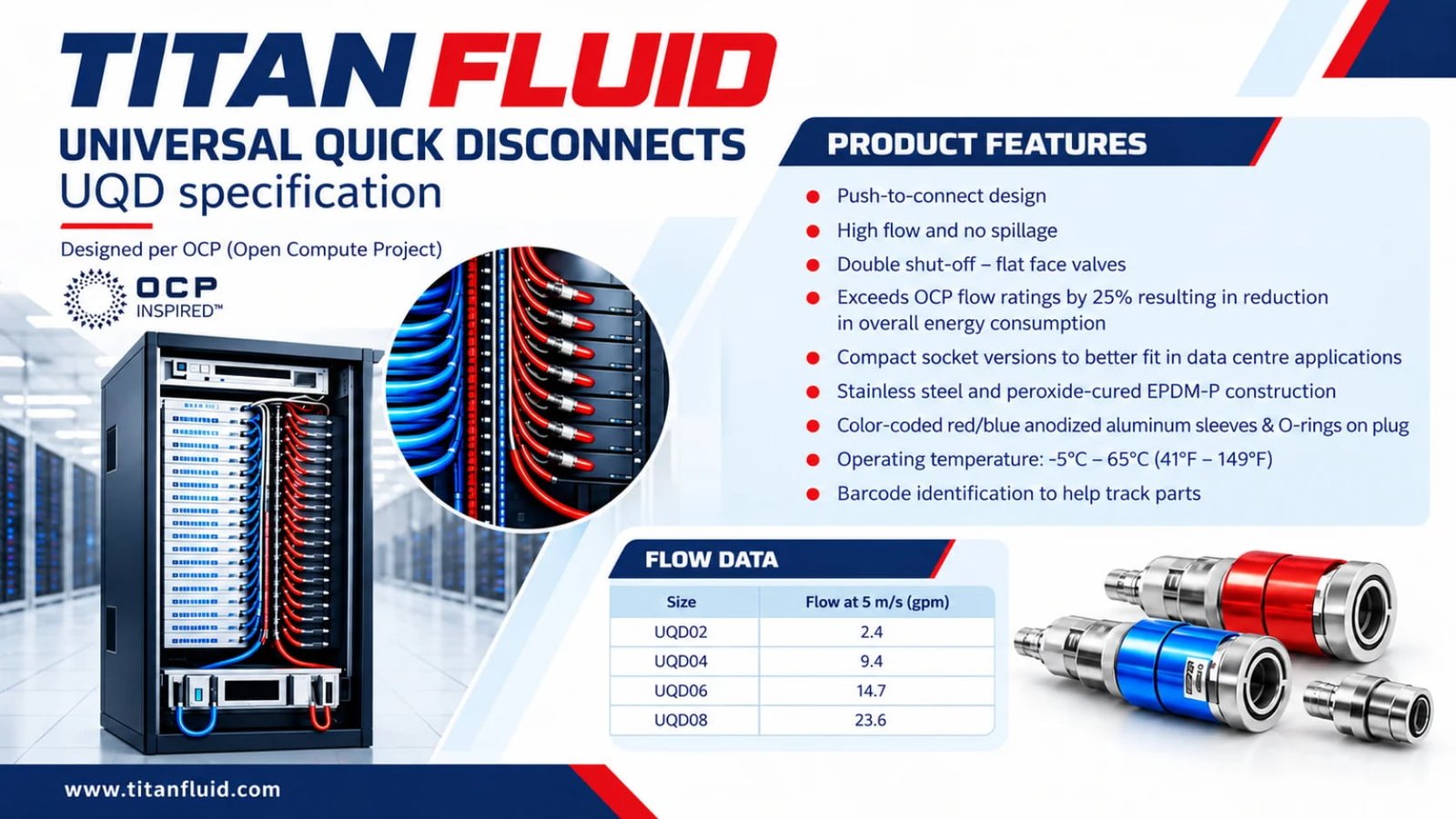
Our TICOOLFLOW POWERED BY TITAN FLUID UQD product range includes four sizes:
| UQD Size | Nominal Flow Diameter | Published Rated Flow | Maximum Operating Pressure |
|---|---|---|---|
| UQD02 | 3.16 mm | 2.1 L/min | 20 bar |
| UQD04 | 6.3 mm | 6.4 L/min | 16 bar |
| UQD06 | 7.9 mm | 11.4 L/min | 6.9 bar |
| UQD08 | 10 mm | 17.8 L/min | 6.9 bar |
I use these values as product reference data, not as universal flow limits. The actual operating point depends on the system’s allowable pressure drop and performance curve.
Our published UQD specifications also include:
- Push-to-connect operation
- Red and blue identification options
- Peroxide-cured EPDM seals
- Flat-face double-shutoff design
- Helium leak testing of every coupling
I recommend reviewing the complete coupling specification before selecting a size.
Best Materials for Liquid Cooling Fittings?
Material selection affects corrosion resistance, maintenance cost, and service life. I avoid choosing stainless steel by price alone because coolant chemistry can change the best option.
304 stainless steel is often suitable for controlled, low-chloride cooling environments, while 316L provides better resistance to chloride-related pitting and crevice corrosion. I select the material based on coolant chemistry, operating temperature, cleaning practices, and the complete system’s metal compatibility.
304 vs. 316L Stainless Steel
I regularly compare SS304 and SS316L for industrial fluid connections.
Both grades provide good mechanical strength and corrosion resistance in many controlled environments.
The main difference is that 316L contains molybdenum, which improves resistance to certain localized corrosion conditions.
| Selection Factor | SS304 | SS316L |
|---|---|---|
| Corrosion resistance | Good in controlled environments | Better in many chloride-containing environments |
| Chloride pitting resistance | Lower | Higher |
| Material cost | Generally lower | Generally higher |
| Welded applications | 304L is preferable when low carbon is needed | Low-carbon grade supports welded applications |
| Controlled treated-water systems | Often suitable after validation | Often suitable after validation |
| More demanding coolant conditions | Requires careful review | Often my preferred starting point |
I usually recommend SS304 when the coolant chemistry is tightly controlled and the customer needs to reduce material cost.
I prefer SS316L when water chemistry is less predictable, chloride exposure is a concern, or the customer wants an additional corrosion-resistance margin.
However, I do not claim that 316L is immune to corrosion.
High chloride concentrations, deposits, stagnant areas, and unsuitable cleaning chemicals can still cause damage.
I also distinguish material grade from component design.
For example, our standard UQD and UQDB product specifications list 303 stainless steel, not 304 or 316L.
I confirm the actual grade for each product family rather than assuming that all stainless steel components use the same alloy.
Corrosion Resistance and Coolant Compatibility
I treat coolant compatibility as a system-level decision.
The coolant contacts more than the fitting body. It may also contact seals, valve seats, hose liners, cold plates, and other metals.
I use the following preliminary compatibility matrix when discussing a new project.
| Coolant Type | 304 Stainless Steel | 316L Stainless Steel | EPDM Seals | FKM Seals |
|---|---|---|---|---|
| Controlled deionized water | Conditional | Conditional | Often suitable | Verify |
| Treated water | Often suitable | Often suitable | Often suitable | Verify |
| Water with inhibited propylene glycol | Often suitable | Often suitable | Often suitable | Verify |
| Water with inhibited ethylene glycol | Often suitable | Often suitable | Often suitable | Verify |
| Mineral oil-based coolant | Evaluate | Evaluate | Generally unsuitable | Often suitable |
I use this matrix for preliminary screening only. Final compatibility depends on the exact coolant formulation, additives, concentration, temperature, exposure time, and seal compound.
I pay particular attention to deionized water because its low initial conductivity does not guarantee long-term compatibility.
Water chemistry can change as it circulates through a system.
I also examine mixed-metal systems.
Copper cold plates, aluminum components, stainless steel fittings, and other metals can create corrosion concerns when coolant chemistry is not properly controlled.
For this reason, I request the coolant manufacturer’s approved material list before finalizing the fitting specification.
At TICOOLFLOW POWERED BY TITAN FLUID, we can provide EN 10204 Type 3.1 material certificates for applicable stainless steel shipments.
I use these certificates to verify material traceability, but I do not treat them as proof of coolant compatibility or completed leak testing.
Liquid Cooling Connection Standards?
Different cooling systems use different connection specifications. Similar-looking couplings may not connect correctly. I verify the exact interface standard before approving any replacement or new design.
OCP-related liquid cooling connections include Universal Quick Disconnect (UQD) and blind-mate designs, while LQC refers to liquid quick-connect interfaces whose requirements depend on the specified product or system. I verify dimensional, sealing, flow, and qualification requirements rather than assuming interchangeability.
OCP LQC Connections
I often see buyers use the term LQC to describe liquid quick-connect couplings.
I clarify the terminology before quoting because LQC alone does not identify one universally interchangeable connector interface.
The Open Compute Project develops open specifications for data center technologies, including liquid cooling connection systems.
When a customer requests an OCP-related LQC connection, I ask for the exact specification, revision, drawing, and mating connector information.
I also review the following details:
- Plug and socket dimensions
- Connection and disconnection forces
- Flow and pressure-drop requirements
- Leakage and spillage limits
- Coolant and seal requirements
- Required qualification tests
I never approve an alternative coupling solely because it has the same nominal size.
UQD Quick Disconnects
I recommend OCP UQD couplings when the cooling system requires a standardized, serviceable liquid connection and the selected components meet the applicable specification.
Our TICOOLFLOW POWERED BY TITAN FLUID UQD range includes sizes UQD02, UQD04, UQD06, and UQD08.
The published design includes flat-face double-shutoff valves and peroxide-cured EPDM seals.
I also offer a Universal Quick Disconnect Blind-Mate (UQDB) range for applications where direct visual access is limited.
Our UQDB design includes a self-alignment feature with 1 mm radial compensation.
I find this especially useful for server and manifold connections that must engage through guided mechanical movement.
| Feature | TICOOLFLOW UQD | TICOOLFLOW UQDB |
|---|---|---|
| Connection method | Manual push-to-connect | Guided blind-mate push connection |
| Available sizes | 02, 04, 06, 08 | 02, 04, 06, 08 |
| Flat-face design | Yes | Yes |
| Standard seal | EPDM-P | EPDM-P |
| Standard body material | 303 stainless steel | 303 stainless steel |
| Radial alignment compensation | Not specified | 1 mm |
| Helium leak testing | 100% of couplings | 100% of couplings |
I still require confirmation of the mating interface, specification revision, and mechanical installation arrangement.
LQC vs. UQD Comparison
I compare LQC and UQD based on the actual interface requirements rather than the names alone.
| Factor | LQC Designation | OCP UQD |
|---|---|---|
| Meaning | Often a general liquid quick-connect designation | Defined universal quick disconnect interface |
| Interchangeability | Depends on exact specification | Depends on compliance with the applicable UQD specification |
| Size selection | Product-dependent | Standardized size families |
| Flow performance | Requires product-specific data | Defined specification requirements and product curves |
| Procurement risk | Ambiguous without drawings | Lower when interface and revision are verified |
I recommend UQD when a customer specifically requires the OCP UQD interface.
I recommend checking the detailed drawing and test specification when a project simply states LQC.
For blind-mate systems, I also verify alignment tolerance, engagement travel, mounting method, and mechanical loads.
How to Select the Right Cooling Fittings?
A fitting may meet its pressure rating but still restrict coolant flow. I evaluate hydraulic performance, material compatibility, and sealing together before choosing a part number.
I select data center liquid cooling fittings by checking maximum pressure, operating temperature, required flow rate, acceptable pressure drop, internal diameter, coolant chemistry, seal material, and connection standard. I validate the complete flow path instead of selecting components by nominal thread size alone.
Pressure and Temperature Ratings
I start with the maximum pressure that the fitting may experience, not only the normal operating pressure.
The system may experience higher pressure during startup, pump changes, valve operation, or testing.
I therefore check:
- Normal operating pressure
- Maximum possible system pressure
- Pressure transients
- Test pressure
- Operating and maintenance temperatures
I also check the weakest component in the assembly.
A hose, seal, valve, or quick disconnect may have a lower pressure rating than the stainless steel adapter attached to it.
For our standard UQD range, the published operating temperature is 10°C to 65°C.
I do not use the wider temperature capability of the EPDM seal material as permission to operate the complete coupling beyond its specified range.
Flow Rate and Fitting Size
I consider this one of the most important engineering decisions.
A fitting’s nominal thread size does not always equal its internal flow diameter.
A small internal restriction increases fluid velocity and pressure loss.
I use the basic flow relationship:
\[ Q=A\times v \]
Where:
- \(Q\) = Volumetric flow rate
- \(A\) = Internal flow area
- \(v\) = Average fluid velocity
For a circular passage:
\[ A=\frac{\pi D^2}{4} \]
When I reduce the internal diameter while maintaining the same flow rate, fluid velocity increases.
For example, reducing the internal diameter from 10 mm to 8 mm increases average velocity by approximately 56% at the same flow rate.
I also consider the approximate relationship between pressure loss and flow velocity:
\[ \Delta P=K\frac{\rho v^2}{2} \]
Here, \(K\) represents the fitting’s loss coefficient and \(\rho\) represents fluid density.
For a fixed loss coefficient, pressure loss increases with the square of velocity.
This means that a small fitting can create a disproportionately large restriction.
I use manufacturer pressure-drop curves for final selection because actual fittings have complex internal passages.
I also calculate the total pressure loss across the system:
\[ \Delta P_{\text{total}}=\Delta P_{\text{pipes}}+\Delta P_{\text{hoses}}+\Delta P_{\text{fittings}}+\Delta P_{\text{cold plates}} \]
For a simple circuit, I add the pressure losses of components in series at the design flow rate.
For parallel rack branches, I also evaluate how the pressure distribution affects flow balance.
I then compare the required flow and total pressure loss with the pump performance curve.
This process helps me avoid two common mistakes:
- Selecting an undersized coupling that restricts cooling.
- Selecting an unnecessarily large coupling that increases cost and installation space.
Coolant and Seal Compatibility
I never select an O-ring only by temperature rating.
The chemical compatibility of the seal matters just as much.
EPDM is commonly used with suitable water and glycol cooling fluids.
FKM may be appropriate for some oil-based fluids, but it is not automatically the best choice for every water-based coolant.
I request the following information from customers before finalizing a seal:
- Coolant manufacturer and product name
- Glycol type and concentration, if applicable
- Additive and inhibitor information
- Operating temperature range
- Cleaning and flushing chemicals
- Required service life
I also check whether the cooling system uses biocides or other water-treatment chemicals.
These additives can affect sealing materials, so I confirm compatibility with the compound manufacturer when needed.
Installation and Maintenance Best Practices?
Even a well-designed fitting can fail after incorrect installation. I focus on cleanliness, correct assembly, and testing because these steps reduce avoidable leaks and maintenance problems.
I prevent liquid cooling connection failures by keeping components clean, following specified tightening procedures, protecting seals, supporting hoses, and testing completed assemblies. I also recommend scheduled inspections for leakage, corrosion, pressure changes, and coupling damage.
Leak Prevention
I start leak prevention before the fitting reaches the installation site.
I require correct material identification, clean machining, and suitable sealing surfaces.
For threaded fittings, I check the specified tightening torque and sealing method.
I avoid using thread sealant on connections that are designed to seal with an O-ring or metal sealing face unless the manufacturer specifically requires it.
For compression tube fittings, I follow the applicable assembly instructions and verify that the tube is fully inserted.
I also inspect tube surfaces for scratches because surface damage can create a leakage path.
For flexible hose assemblies, I avoid excessive twisting and bending.
I make sure the hose has enough length to move naturally without pulling against the connector.
For quick disconnect couplings, I check that the plug and socket are correctly aligned and fully engaged.
I also protect disconnected coupling faces from dirt and physical damage.
Testing and Inspection
I separate material verification from performance testing.
An EN 10204 Type 3.1 material certificate supports material traceability, but it does not replace a leak test.
For critical cooling connections, I consider several inspection methods.
| Test or Inspection | What I Want to Verify |
|---|---|
| Visual inspection | Surface condition and assembly quality |
| Dimensional inspection | Interface and thread accuracy |
| Material certificate review | Material grade and traceability |
| Pressure test | Pressure containment under specified test conditions |
| Helium leak test | Very small leakage paths |
| Flow and pressure-drop test | Hydraulic performance |
| Connection-cycle test | Durability during repeated service |
Our TICOOLFLOW POWERED BY TITAN FLUID UQD and UQDB specifications state that every coupling receives helium leak testing.
I consider this valuable for data center applications, but I still require the applicable acceptance limit and test method when reviewing a qualification package.
I also recommend documenting installation and inspection records.
For larger projects, I prefer clear batch identification and traceable test reports.
These records make it easier to investigate any issue that appears during operation.
Frequently Asked Questions?
Buyers often ask whether standard hydraulic fittings can be used in data center cooling. I answer these questions by comparing actual system requirements rather than relying on product labels.
I recommend selecting liquid cooling fittings based on verified coolant compatibility, flow performance, sealing reliability, and connection standards. Stainless steel is often a practical choice, but the correct grade, coupling size, and seal depend on the specific cooling system.
Can I Use Standard Hydraulic Fittings in a Data Center Cooling System?
I consider standard hydraulic fittings when their materials, dimensions, pressure ratings, and sealing methods meet the cooling system requirements.
However, I do not assume that high hydraulic pressure ratings guarantee good cooling performance.
I also evaluate cleanliness, flow restriction, seal compatibility, and leakage requirements.
Is 316L Stainless Steel Always Better Than 304?
I prefer 316L when the coolant environment presents greater corrosion risks, especially chloride-related concerns.
I may recommend 304 for controlled cooling loops where the chemistry is suitable and the customer wants to reduce cost.
I make the final choice using the actual coolant specification.
What Is the Difference Between UQD and UQDB?
I use UQD for serviceable push-to-connect liquid cooling interfaces.
I use UQDB when a guided blind-mate connection is required, such as a server connection where visibility and access are limited.
Our UQDB specification includes 1 mm radial alignment compensation.
How Do I Know Whether a Quick Disconnect Is Large Enough?
I compare the required flow rate with the coupling’s pressure-drop curve.
I also check the pressure available at the server and the total resistance of the cooling branch.
I do not select a coupling by thread size alone.
Which Seal Is Best for Water-Glycol Cooling?
I often begin with EPDM for suitable inhibited water-glycol mixtures.
However, I verify the exact glycol formulation, additives, operating temperature, and seal compound before approving it.
What Documents Should I Request From a Supplier?
I recommend requesting material certificates, dimensional drawings, product specifications, applicable compliance information, and relevant test reports.
I also check whether the supplier can trace the delivered parts to the correct production batch.
How Can I Reduce Procurement Risks When Sourcing From China?
I recommend agreeing on the technical specification before confirming the order.
I also clarify inspection requirements, certificate format, packaging, delivery schedule, and payment terms.
For custom products, I prefer sample approval before mass production.
Find the Right Data Center Liquid Cooling Fittings?
Choosing a supplier involves more than comparing unit prices. I see buyers lose time when drawings, certificates, or delivery expectations remain unclear. I prefer to resolve these details before production.
I help customers select stainless steel cooling connections by reviewing technical drawings, materials, flow requirements, sealing options, and documentation needs. At TICOOLFLOW POWERED BY TITAN FLUID, I focus on reliable manufacturing, clear communication, and practical sourcing support for international B2B buyers.
What Can I Supply for Liquid Cooling Projects?
At TICOOLFLOW POWERED BY TITAN FLUID, I work with purchasing teams, technical managers, and OEM customers who need stainless steel fluid connections.
Our company was founded in 2015, and we now serve customers in more than 50 countries.
We are also an approved supplier to major OEMs in North America and Europe.
For liquid cooling projects, I can help customers evaluate relevant products from our portfolio.
| Product Category | Typical Cooling Application |
|---|---|
| Stainless steel hydraulic adapters | Thread and port transitions |
| Stainless steel instrumentation tube fittings | Rigid tubing and manifold connections |
| Stainless steel hydraulic hose fittings | Flexible hose terminations |
| Stainless steel DIN fittings | Compatible metric tube connections |
| UQD quick disconnect couplings | Serviceable server and rack connections |
| UQDB blind-mate couplings | Guided server-to-manifold connections |
I confirm each product’s suitability for the actual cooling application before recommending it.
What Information Do I Need for a Quotation?
I can provide a more accurate technical recommendation and quotation when I receive the key operating details.
I have prepared the following selection checklist for buyers and engineers.
Data Center Liquid Cooling Fittings Selection Checklist
- Cooling application and connection location
- Coolant type, brand, and concentration
- Required stainless steel grade
- Design flow rate and allowable pressure drop
- Normal and maximum system pressure
- Operating and test temperature range
- Tube, hose, and port dimensions
- Connection standard and specification revision
- Required seal material and compatibility
- Order quantity and delivery schedule
- Certificates, drawings, and test reports
I recommend completing this checklist before sending an RFQ.
A complete technical request helps reduce quotation delays and prevents misunderstandings during production.
How Can I Request a Technical Review or Quotation?
I welcome technical drawings, product lists, and project specifications.
I can review the required material grade, connection dimensions, coolant compatibility, and available product configurations.
I also discuss documentation, inspection, packaging, and delivery requirements before order confirmation.
For OEM buyers and distributors, I understand the importance of consistent quality and dependable communication.
I recommend including expected annual volume and target delivery dates in the initial inquiry because these details help us evaluate production planning and commercial requirements.
Conclusion
I recommend selecting data center liquid cooling fittings through careful checks of flow, pressure, materials, seals, and connection standards. Reliable fittings protect cooling performance and long-term operation.